
It was supposed to be a routine budget hearing for the Department of Justice, a procedural affair of spreadsheets, statistics, and polite inquiries. But when Senator Rodante Marcoleta took the floor, the atmosphere inside the Senate hearing room crackled, transforming the bureaucratic meeting into a high-stakes legal cross-examination.
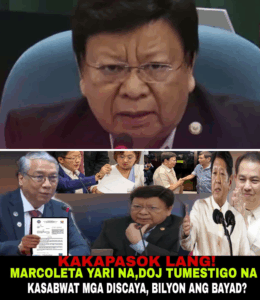
In a fiery and relentless confrontation, Marcoleta grilled top DOJ officials, accusing the department of “supplanting” the law with its own opinions and “imagining” legal provisions that do not exist. The clash centered on two explosive national issues: the obstruction of whistleblowers in a massive flood control scam and the questionable legal basis for transferring a former president to the International Criminal Court (ICC).
The confrontation began not with a bang, but with a philosophical probe. Marcoleta, bypassing the budget figures, wanted to know how the DOJ’s achievements—case disposition rates, jail decongestion—were actually felt by the public.
“How can we make our ordinary citizen appreciate all this?” he pressed, arguing that statistics are cold comfort to a populace that still feels justice is elusive.
Undersecretary Jessie Andres parried, outlining significant reforms: a higher standard of evidence to prevent frivolous cases, a Php10,000 cap on bail for the indigent, and the release of 26,000 inmates since 2022 due to digitized records.
But Marcoleta was unimpressed. He shared a pointed anecdote of a constituent allegedly blocked from filing a case against an “influential member of our society” by a discouraging fiscal. The message was clear: the DOJ’s reforms, he implied, were not reaching the ground.
With the foundation of “real-world justice” laid, Marcoleta pivoted to his first major assault: the “flood control anomalous projects.”
As the former chairman of the Blue Ribbon Committee, Marcoleta recounted his efforts to nail the “masterminds” behind a sprawling corruption scandal, not just the “small fish.” He explained that he had convinced 15 contractors to cooperate, leading to the emergence of the Discaya couple, who allegedly came forward and enumerated 17 members of Congress involved in the scheme.
Marcoleta had recommended them for the Witness Protection Program (WPP). But there was a wall. The DOJ, under the former Secretary (now the Ombudsman), insisted on a condition: the Discayas must provide restitution first.
This, Marcoleta thundered, was the heart of the problem.
“I told him it is not a requirement under the law,” Marcoleta said, his voice rising, referencing Section 10 of the WPP law (RA 6981). He claimed the former Secretary admitted it wasn’t in the law but insisted it was “good policy.”
“Do you agree with it?” he demanded of the new DOJ panel.
Undersecretary Andres, defending the department’s stance, pointed to a different section—Section 5, letter D—which mentions “legal obligations and civil judgments.” She argued that this, combined with the civil code’s provisions on “unjust enrichment,” gave the DOJ the latitude to demand restitution.
Marcoleta visibly bristled, cutting her off. “You are imagining something that is not within the law. You are Department of Justice,” he shot back. “You are supplanting the very clear and categorical provision of law by… your opinion.”
He hammered the point home, noting that the WPP has a 95.3% case success rate, even higher than general prosecution. Why, he demanded, would the DOJ obstruct a program that so effectively brings criminals to justice, especially when the masterminds—17 congressmen—were on the line?
The tense exchange left the DOJ officials scrambling to defend a policy that Marcoleta had effectively painted as a barrier to justice, potentially shielding powerful figures.
Before the panel could recover, Marcoleta shifted to a seemingly unrelated, philosophical trap. He brought up a statement from a former official: “Sometimes you have to bend the law to please our people.”
He asked Undersecretary Andres, “Do you agree?”
“I do not agree,” Andres stated firmly. “Basically, in implementing the law there are positions you can take, but bending the law is not one of them.”
Marcoleta praised her answer. “No one is above the law,” he agreed. But the trap was sprung. By getting the DOJ to commit to the inflexibility of the law, he had set the stage for his second, and perhaps more constitutionally significant, line of attack.
“Let’s go to the ICC,” Marcoleta said, the room growing quiet. He questioned the DOJ’s role in the transfer of a former president to the international tribunal, particularly after the current President had repeatedly stated he would not assist the ICC. What, he asked, “necessitated a change of mind?”
When officials stated they were not privy to those specific circumstances, Marcoleta zeroed in on the legal justification itself. He cited Republic Act 9851, the “Philippine Act on Crimes Against International Humanitarian Law.”
He read directly from its text, establishing that Section 17 grants Philippine courts “original and exclusive jurisdiction” over such crimes. Why, then, was the former president not prosecuted here, in a Philippine court?
Chief Dennis Chan, a DOJ legal expert, stepped in, offering the department’s justification. He explained that the former Justice Secretary had relied on the second paragraph of that same Section 17. That paragraph states that Philippine authorities “may dispense with the investigation or prosecution” if “another court or international tribunal is already conducting the investigation.”
This, Chan explained, allowed the state to “surrender or extradite” the accused to the international court.
It was the answer Marcoleta was waiting for.
“Exactly,” Marcoleta said, leaning into the microphone. He pointed out that the very paragraph the DOJ was using as its shield contained a fatal condition. It allows for surrender, he quoted, “pursuant to the applicable extradition laws and treaties.”
This was his “gotcha” moment.
“The Philippines has withdrawn from the Rome Statute,” Marcoleta declared, laying out his closing argument. The Rome Statute is the treaty that established the ICC. “There is no extradition treaty between the Philippines and the ICC. Therefore, that second paragraph cannot be invoked as a legal basis!”
He concluded that the DOJ’s entire justification for the transfer was “wrong” and that under the “original and exclusive jurisdiction” clause, the former president should have been tried in the Philippines.
The DOJ officials could only offer that the matter was still pending before the Supreme Court, a tacit admission that the legal ground was, at best, contested.
The hearing, which began with a discussion of budgets, had ended with a fundamental challenge to the DOJ’s legal authority and fidelity to the law. Senator Marcoleta had left the panel, and the public, with two deeply unsettling questions: Is the Department of Justice “bending the law” to prevent 17 congressmen from being exposed? And did it do the same to surrender a former president, in violation of its own statutes? The search for answers, it seems, has only just begun.
News

Ang High-Tech na Mansyon ni Alden: Bakit Ang Dream House ng Aktor ay Literally Katabi ng Bahay ni Kathryn Bernardo
Ang mundo ng showbiz ay isang entablado kung saan ang pangarap ay nagsasaling-wika sa katotohanan, at ang pag-ibig ay madalas…

Araw ni Bonifacio 2025: Ang Trillion Peso March, Pagtawag ni Catriona Gray sa Pananagutan, at Ang “Under Control” na Gulo sa Mendiola
Ang Araw ni Bonifacio, na ginugunita tuwing Nobyembre 30, ay tradisyonal na ginagamit bilang plataporma ng sambayanan upang ipahayag ang…

Ang Laban ng mga Mana: Eman vs. Jimwel Pacquiao – Sino sa mga Anak ni Manny Ang Hahawak sa World Title ng Boxing
Sa mundo ng professional boxing, ang pangalan ni Manny “Pacman” Pacquiao ay hindi lamang isang apelyido; ito ay isang simbolo…

Ginto, Bilyong Insertions, at Ang ICC Drama: Ang Naglalagablab na Katotohanan sa Likod ng Marcos Administration’s Sekreto
Ang pulitika sa Pilipinas ay muling nagliliyab, hindi dahil sa isang kakaibang celebrity gossip, kundi dahil sa mga seryoso at…

Ang Second Life sa Kabaong: Paano ang Isang Pari, na Dating Combat Medic, ang Nagbunyag ng Drug Smuggling at Nagligtas ng Buhay sa Gitna ng Libing
Ang buhay ay madalas na punong-puno ng pagbabago, at ang paghahanap ng layunin ay kung minsan ay matatagpuan sa mga…

Ang No-Fail Test ng Kabutihan: Paano ang Helicopter Crash ang Nagbunyag sa Tunay na Ugali ng Kasintahan at mga Empleyado ng Bilyonaryo
Ang tunay na yaman ay hindi nasusukat sa dami ng ari-arian o sa bigat ng bank account; ito ay matatagpuan…
End of content
No more pages to load