
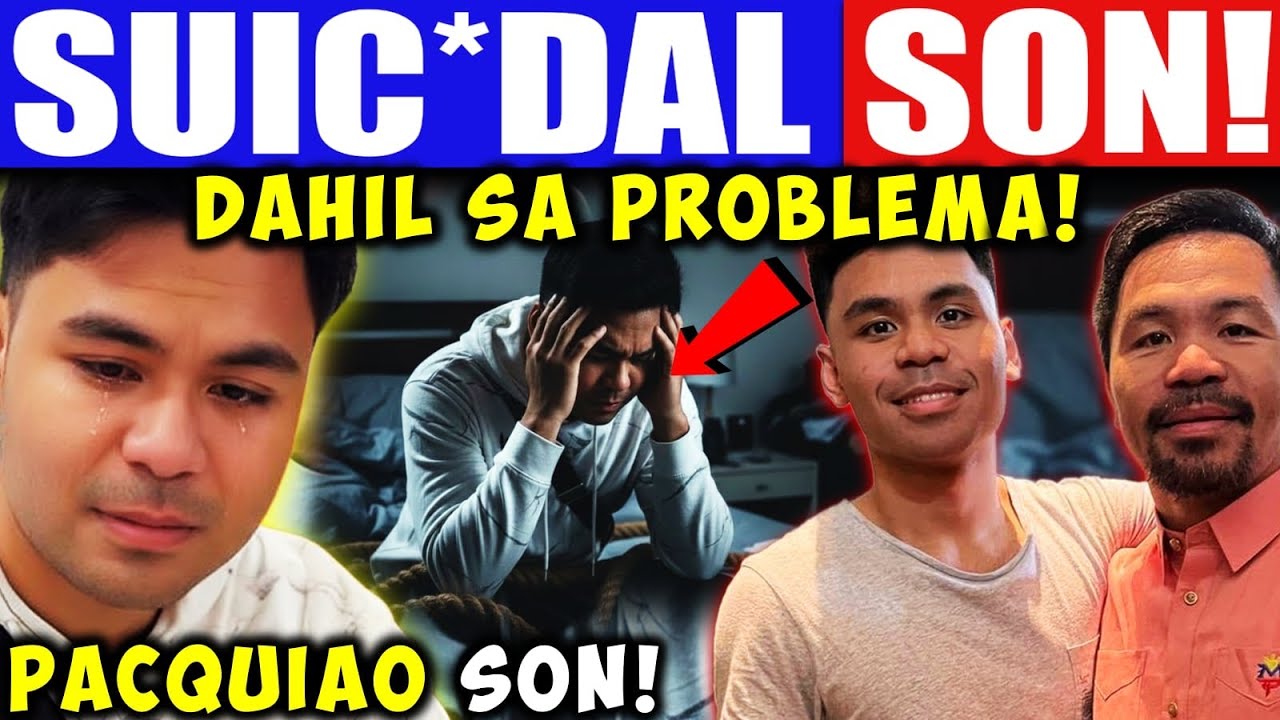
In the collective consciousness of the public, the name “Pacquiao” is synonymous with strength, resilience, and unparalleled victory. It conjures images of Manny Pacquiao, the “Pambansang Kamao” (National Fist), rising from abject poverty to become a global boxing icon and a billionaire senator. It is a classic rags-to-riches fairy tale that the world adores. However, for his second son, Michael Pacquiao, the narrative is vastly different. While his father fought physical opponents in the ring, Michael has been fighting invisible demons in his mind—battles that no amount of money, luxury, or fame could easily win.
Recently, Michael Pacquiao made headlines not for a boxing match or a political bid, but for a courageous and raw admission regarding his mental health. In a society that often equates wealth with total well-being, Michael’s revelation that he suffers from mental health issues, including depression and anxiety, has sparked a firestorm of discussion. It has forced a re-examination of the age-old question: Can money truly buy happiness? For Michael, the answer is a resounding and painful no.
The Golden Cage of Expectation
To the outside observer, Michael’s life looks like a dream. He lives in mansions, travels the world, and has access to resources most people can only imagine. But in his candid interviews, Michael describes a life that feels less like a paradise and more like a golden cage. Being the son of a living legend comes with a suffocating weight of expectation.
From a young age, the public gaze has been fixed on the Pacquiao children. There is an unspoken pressure to emulate the greatness of the patriarch. While his brother Jimuel tried his hand at boxing, Michael charted a different path—music. However, this deviation didn’t free him from scrutiny; it only intensified it. Every move he made was compared to his father’s discipline and success.
Michael has opened up about the feeling of invalidation he often experiences. Because he was born into privilege, society often dictates that he has “no right” to be sad. How can you be depressed when you have everything? This stigma is dangerous. It forces individuals in his position to suppress their emotions for fear of being labeled ungrateful or spoiled. Michael’s admission shatters this misconception, highlighting that mental health disorders are biological and psychological issues that do not discriminate based on socioeconomic status.
Music as a Cry for Help
The public first got a glimpse of Michael’s internal world when he released his rap track, “Hate.” While many initially dismissed it as a “rich kid trying to be a rapper,” a closer listen to the lyrics reveals a young man processing deep-seated pain. The song wasn’t just a hobby; it was a survival mechanism.
In various interactions and interviews, Michael has explained that music became his therapy. When he felt he couldn’t speak to anyone because they wouldn’t understand—or worse, would judge him for complaining despite his wealth—he turned to the microphone. He rapped about the judgments, the isolation, and the feeling of being misunderstood.
The backlash he received for his music only fueled his anxiety. The internet can be a cruel place, and netizens were quick to mock his style, his voice, and his background. For someone already struggling with self-worth and battling dark thoughts, this cyberbullying was a heavy blow. Yet, Michael persisted. He used the negativity as fuel, proving that his passion for music was genuine. It was his way of carving out an identity separate from the looming shadow of his father.
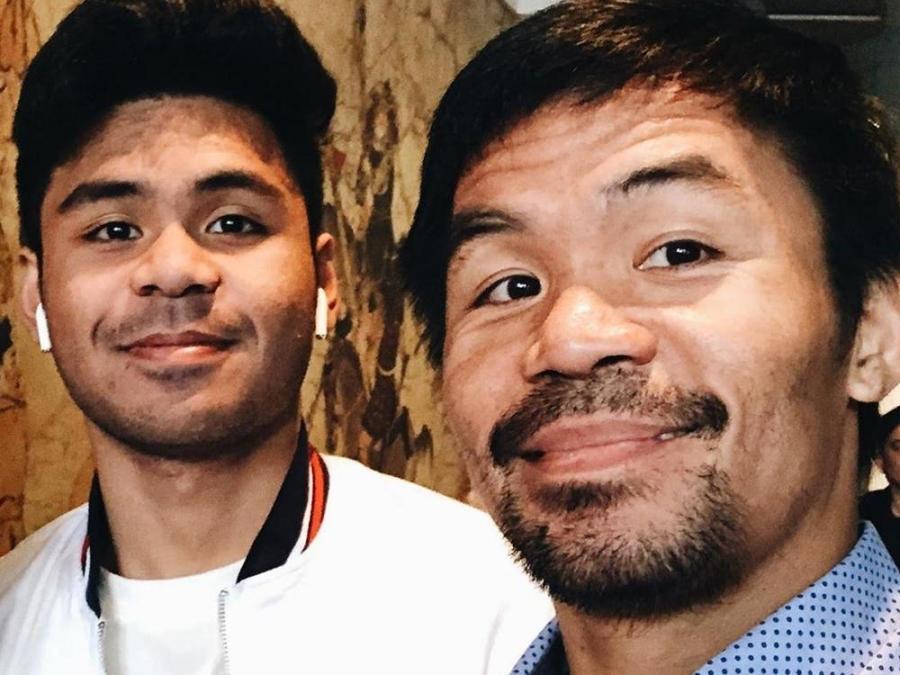
The Reality of Depression in High Society
Michael’s vulnerability brings to light a topic rarely discussed in the Philippines: the mental health struggles of the elite. There is a pervasive myth that financial security eliminates worry. While it is true that money solves survival problems—food, shelter, healthcare—it does not solve existential ones.
Michael has shared moments of intense loneliness. He has spoken about crying in his room, feeling an emptiness that the latest gadgets or designer clothes could not fill. This is a classic symptom of clinical depression—anhedonia, or the inability to feel pleasure in things that should be enjoyable.
His story serves as a crucial reminder that the brain’s chemistry does not check a bank balance. Trauma, chemical imbalances, and environmental stressors affect everyone. In fact, the isolation of fame can often exacerbate these issues. When everyone around you wants something from you, or when you constantly question if people like you for you or for your last name, trust becomes difficult. This isolation breeds anxiety and paranoia, further spiraling into depression.
Breaking the Cycle of Silence
Perhaps the most commendable aspect of Michael’s journey is his willingness to speak out. In many traditional families, especially those in the public eye, mental health issues are swept under the rug to protect the family image. Admitting to “mental problems” can be seen as a weakness.
By acknowledging his struggles, Michael Pacquiao is breaking a generational cycle of silence. He is showing that it is okay to be vulnerable. He is showing that even the son of the toughest man in the world can have moments of fragility. This does not make him weak; in many ways, it makes him stronger. It takes a different kind of courage to face an opponent you cannot see, an opponent that lives inside your own head.
His father, Manny, has built a legacy on physical strength and generosity. Michael is building a legacy on emotional honesty. He is teaching a generation of young Filipinos that they do not have to suffer in silence, regardless of who their parents are or what society expects of them.
A Call for Empathy
The reaction to Michael’s revelation has been mixed, but it has largely shifted toward empathy. People are beginning to see him not just as “Pacman’s son,” but as a human being trying to navigate a complex life. His story is a lesson in empathy. We never truly know what someone is going through behind closed doors.
The “rich kid” stereotype is a dehumanizing label that strips a person of their right to struggle. Michael’s story challenges us to look beyond the surface level of Instagram posts and luxury cars. It asks us to recognize the humanity in everyone.
As Michael continues his journey—focusing on his music, his personal growth, and his health—he carries a new title. He is no longer just the son of a billionaire boxer; he is a mental health advocate. He is a survivor. And for the thousands of young people who feel alone in their struggles, seeing someone like Michael Pacquiao fight his demons gives them hope that they can fight theirs too.
The battles Michael fights are not in a ring in Las Vegas with millions watching. They happen in the quiet moments, in the studio, and in the privacy of his home. But just like his father, he is proving to be a fighter. He is fighting for his peace, his identity, and his happiness. And that is a fight worth cheering for.
News

GULAT ANG LAHAT! Toby Tiangco, Huli sa Video na Nagtatangkang Harangin ang Suspensyon ni Kiko Barzaga – ‘Trojan Horse’ sa Kongreso Nabunyag?
Sa isang mainit na tagpo sa loob ng Batasang Pambansa na tila hinugot sa isang pelikula, isang hindi inaasahang “plot…

HINDI NA NAKAPALAG! Kiko Barzaga, Pinatayan ng Mikropono at Sinuspendi ng 60 Araw Matapos ang Matinding Harapan sa Kongreso Dahil sa ‘Fake News’
Sa isang mainit at dramatikong tagpo sa loob ng Batasang Pambansa, tuluyan nang ibinaba ang kamay na bakal laban…

GUARD! KALADKARIN NIYO PALABAS ANG MATANDANG ‘YAN! ANG BAHO NIYA, NAKAKAHIYA SA MGA PASYENTE KO!
Napakalakas ng bagyo nang gabing iyon sa lungsod. Ang hangin ay humahagupit sa mga bintana ng St. Luke’s Medical City…

LUMAYAS KA RITO! ANG BAHO MO! WALA KANG PAMBAYAD KAYA WALA KANG KARAPATANG MAGPAGAMOT DITO!
Sa gitna ng abalang lungsod ng Makati, nakatayo ang St. Raphael Medical Center, isang ospital na kilala sa makabagong kagamitan,…

The Uncomfortable Truth Exposed: Why the World’s Wealthiest Nations Are Reportedly Laughing at the Philippines and the Shocking Reason Behind Their Sudden Loss of Respect for the Pearl of the Orient!
It is a bitter pill to swallow for every patriotic Filipino, but a disturbing narrative is quietly circulating within the…

ARGUS Touches Hearts on Showtime as He Emotionally Bids Farewell to His Father
Manila, Philippines — It was a tear-filled episode of It’s Showtime as young singing sensation Argus delivered one of the most emotional…
End of content
No more pages to load