
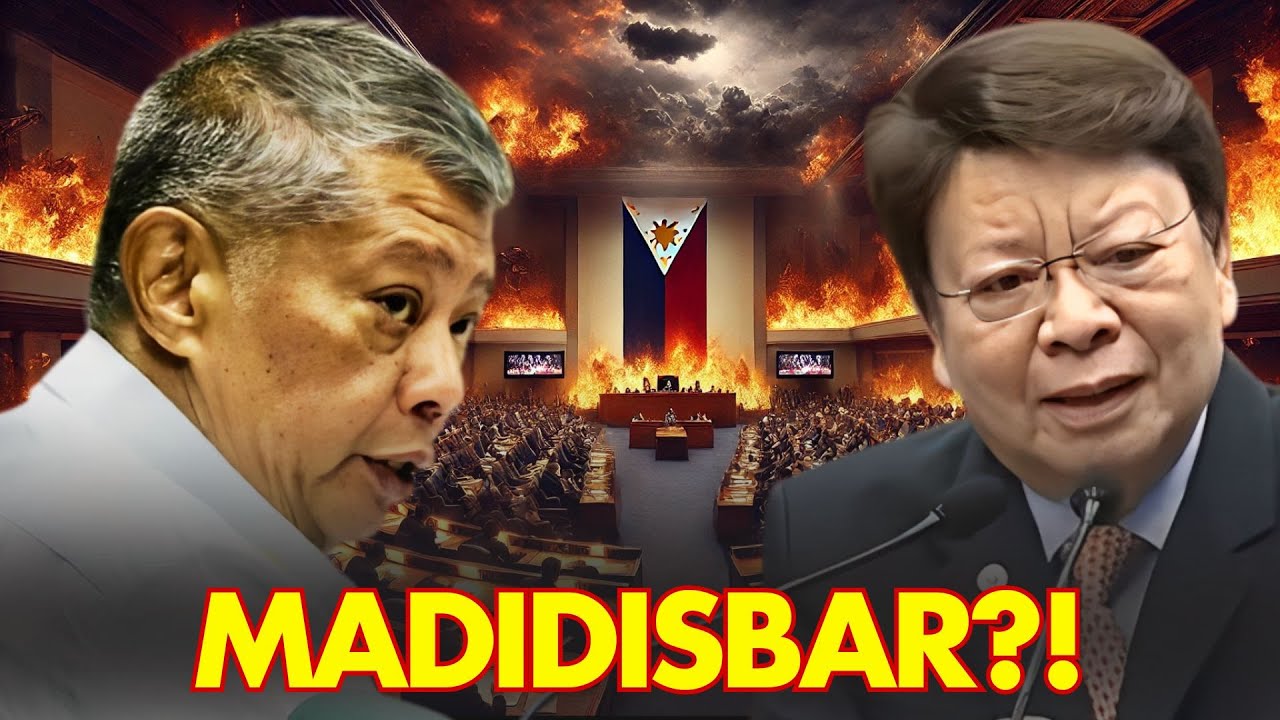
The halls of the Philippine Senate recently became the arena for a high-stakes legal and moral showdown that captivated the nation. At the heart of the conflict: a fiery exchange between Justice Secretary Jesus Crispin Remulla and Senator Rodante Marcoleta over one explosive question—must an individual applying for state witness protection first return their ill-gotten gains?
The dramatic confrontation, sparked during a Senate Blue Ribbon Committee hearing on massive flood control anomalies, resulted in a public disbarment threat from the Senator to the head of the Department of Justice. But in a stunning reversal that unfolded in the following days, the most respected legal authority in the country—the Integrated Bar of the Philippines (IBP)—stepped in, not only to defend the Secretary’s position but to assert that his seemingly “moral” requirement was, in fact, a clear legal mandate.
This is the definitive story of how the principle of justice prevailed over the politics of legal literalism, and how one crucial section of law proved to be the decisive factor in an epic legal duel.
The Spark: A Secretary’s Call for Moral Accountability
The core of the dispute lay in the DOJ’s condition for admitting individuals, specifically the ‘Discayas’ couple involved in the flood control kickback scandal, into the Witness Protection Program (WPP). Secretary Remulla insisted that before granting the security and immunity offered by the WPP, applicants must demonstrate their sincerity and good faith by restituting—or returning—the funds they allegedly stole from the public coffer.
Remulla’s stance was both simple and powerful. He argued that while the literal text of the Witness Protection, Security and Benefit Act (Republic Act No. 6981) may not explicitly list “restitution” as a pre-requisite, the principle was a non-negotiable moral foundation for justice.
“It’s not only in the law that this is dictated,” Remulla stated. “It’s also what is morally right—what is expected of us. Even if that’s not stated in the law, that’s a given in our society.” He emphasized that in the context of a massive financial crime against the Filipino people, justice demands the preservation of national resources, arguing that restitution could and should come before or at the outset of the protection process.
The Senator’s Disbarment Threat: A Line Drawn in the Sand
This position immediately drew the ire of Senator Marcoleta, who vehemently argued that the Secretary was usurping the power of the legislature by “changing the provision of law.” The Senator accused Remulla of setting an arbitrary, extra-legal requirement, insisting that restitution could only be determined after the court process had been completed and findings on the amount had been made.
In a moment of raw, televised tension, Marcoleta delivered the ultimate warning to his fellow lawyer, who also happens to be a Cabinet Secretary: “I said I am not expressing an opinion here. I am articulating the provision of law. You do not change the provision of law, Mr. Secretary. You may be disbarred from doing this.”
The threat—public, professional, and chilling—framed the conflict as the Secretary’s subjective opinion versus the Senator’s unwavering adherence to the statutory text. For a moment, it seemed Marcoleta had the stronger legal footing, clinging to the idea that if a requirement is not explicitly written, it cannot be imposed.
The Integrated Bar’s Intervention: Section 5 as the Decisive Weapon
The political and legal landscape dramatically shifted when the head of the country’s national organization of lawyers, IBP President Alan Panolong, stepped into the fray. In a methodical and non-partisan manner, Panolong provided an expert legal analysis that not only validated Secretary Remulla’s position but entirely dismantled Senator Marcoleta’s argument.
Panolong’s analysis centered on the often-overlooked provision of Republic Act No. 6981 itself, the very law the Senator claimed to uphold. He cited Section 5 of R.A. 6981, which outlines the requirements for a person to be admitted into the WPP. This section mandates that before a person is provided protection, they must first execute a Memorandum of Agreement (MOA) which sets out their responsibilities, including compliance with “legal obligations and civil judgments against him.”
The IBP President clarified that the return of ill-gotten wealth is not a mere moral suggestion—it is a legal obligation under the principle of unjust enrichment, which is a fundamental concept enshrined in the Civil Code of the Philippines (specifically Articles 22 and 23). This principle dictates that a person who acquires or retains something at the expense of another without just or legal ground must return it.
Panolong elaborated: “If you received money that you were not entitled to, it must be returned… This is an obligation under the law.” Therefore, demanding the restitution of public funds, which were allegedly obtained through illegal kickbacks, is a reasonable request for the DOJ to make as a demonstration of “sincerity” and “good faith” before entering the protective and beneficial contractual agreement of the WPP. The return of the money becomes compliance with a pre-existing “legal obligation,” as required by Section 5.
In effect, the IBP President provided the statutory citation that Marcoleta had demanded, proving the Justice Secretary was not amending the law but was expertly enforcing the spirit and underlying principles of the law as they relate to financial crimes and civil obligations. The public threat of disbarment, meant to intimidate the Secretary, ironically became a public demonstration of the Senator’s own oversight of a crucial statutory provision and legal doctrine.
The Principle of Justice: More Than Just the Letter of the Law
The outcome of this highly publicized legal debate has profound implications for the fight against corruption. It solidifies the DOJ’s administrative authority to require a tangible sign of repentance—the return of the loot—as a condition for granting immunity. This move prevents an absurd and unjust scenario where a witness could secure lifetime protection and a new identity while comfortably keeping the billions stolen from the public treasury.
Furthermore, this episode reasserts the vital relationship between the ‘letter’ and the ‘spirit’ of the law. As eloquently summarized by another legal expert, Attorney Joseph Noel Strada, without restitution, one might simply be using the law as a shield to escape prosecution while retaining the stolen funds. The requirement for restitution is thus a fundamental measure of authenticity and a prerequisite for genuine justice.
In the end, this clash was more than a mere legal argument. It was a clear affirmation that the law, when interpreted correctly and holistically, does not permit unjust enrichment at the expense of the state, even in the process of seeking immunity. The ultimate beneficiary is the Filipino public, who are now assured that for those who profited from corruption, there is a clear, unavoidable price to pay for freedom and protection: giving back what was never rightfully theirs. The Secretary’s courage to stand on a moral and principled reading of the law, backed by the highest legal body, signals a new, tougher era in the pursuit of accountability.
News

Janitress na Itinakwil ng Pamilya ng Boyfriend Noon, Ginulat ang Lahat Nang Magpakilala Bilang CEO sa Kanilang Family Reunion!
Hindi habang buhay ay nasa ilalim tayo. May mga pagkakataon na ang mga taong inaapakan at minamaliit noon ay sila…

ANG MEKANIKONG NAKABISIKLETA: PAANO PINAHIYA NG ISANG DALAGA ANG 10 ESPESYALISTA AT PINALUHOD ANG ISANG BILYONARYO SA PAGPAPAKUMBABA
Sa ilalim ng nakapapasong init ng araw sa Uberlandia, Brazil, isang eksena ang umagaw sa atensyon ng marami—isang tagpo na…

DAYUHANG NAGHANAP NG PAG-IBIG SA CEBU, SINAPIT ANG MALAGIM NA WAKAS SA KAMAY NG ONLINE SYNDICATE
Sa mundo ng teknolohiya, tila napakadali na lamang maghanap ng koneksyon. Isang click, isang chat, at maaari ka nang makatagpo…

RETIRED SECRET AGENT, Naging Tricycle Driver Para sa Pamilya, Niligtas ang Bilyunaryang CEO Mula sa Kapahamakan at Binago ang Takbo ng Korapsyon sa Kumpanya!
Sa gitna ng mausok, maingay, at masikip na eskinita ng Tondo, may isang anino na tahimik na namumuhay. Si Elias…

Magsasaka, Ginipit ng Milyonarya: “Bigyan Mo Ako ng Anak o Ipapahabol Kita sa Aso” – Ang Kwento ng Pagbangon ni Noelito
Sa isang liblib na baryo sa San Isidro, kung saan ang hamog ng umaga ay humahalik pa sa mga dahon…

Batang Taga-Bundok, Hinamak sa Bangko Dahil sa Lumang Damit—Natahimik ang Lahat Nang Makita ang ₱100 Milyon sa Kanyang Account!
Sa mata ng marami, ang tagumpay ay nasusukat sa kintab ng sapatos, ganda ng damit, at garbo ng pamumuhay. Madalas,…
End of content
No more pages to load