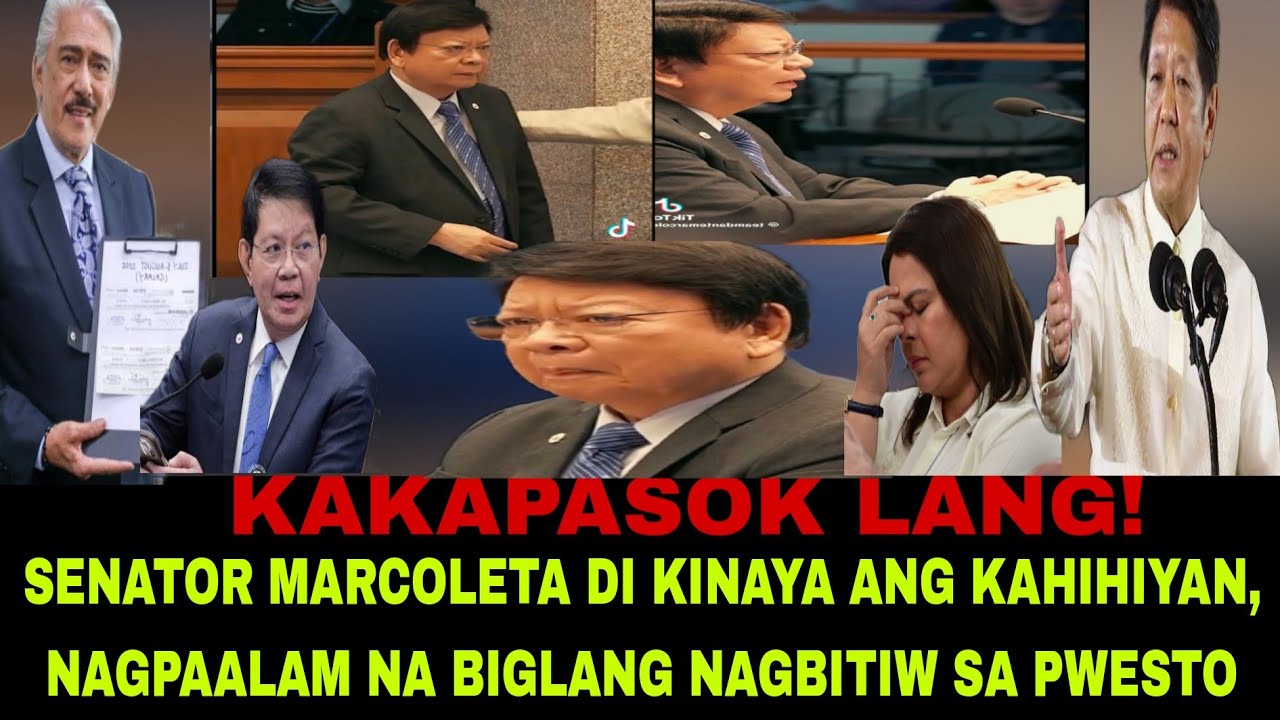
The political landscape is reeling from a dramatic confluence of events: a high-stakes legislative inquiry colliding with an explosive personal financial disclosure controversy. At the heart of the maelstrom is a prominent Senator, Marcoleta, who has been placed squarely in the spotlight over a staggering discrepancy between his declared net worth and his campaign expenditures, a situation that now involves an unprecedented public admission about undeclared campaign donations. The fallout has not only raised serious questions about election finance transparency but has also fueled an open and heated conflict between him and a colleague, Senator Ping Lacson, over procedural matters in a separate, ongoing probe.
The Financial Black Hole: $100 Million Missing in Action
The core of the issue stems from an apparent incoherence between Senator Marcoleta’s Statement of Assets, Liabilities, and Net Worth (SALN) and his Statement of Contributions and Expenditures (SOCE) submitted to the Commission on Elections (COMELEC) following the May 2025 Senatorial elections.
According to the analysis brought to light, Marcoleta’s campaign expenditures, as declared in his SOCE, amounted to over ₱100 million. However, a critical point of contention immediately surfaced when this figure was cross-referenced with his declared net worth in his SALN, which reportedly stood at a significantly lower figure—approximately ₱52 million.
This massive financial chasm immediately begged a fundamental question: How can a candidate spend more than double their declared personal wealth on a campaign?
Under standard election law interpretation, campaign funds are classified into two categories: personal funds spent by the candidate, and contributions (donations) received from others. For the numbers to logically cohere, if the expenditure of ₱100+ million exceeded his personal net worth of ₱52 million, the difference would have to be covered by declared donations.
The truly shocking revelation, however, was Marcoleta’s official submission of his SOCE: zero in declared contributions. The immediate implication of a zero-donation declaration is that the entire ₱100+ million expenditure must, by law, be considered money spent from his own pocket—a near-impossible feat given his declared net worth.
The Defense of Anonymity: A Jaw-Dropping Confession
The Senator, addressing the controversy on his program, provided a defense that has since sent shockwaves through the legal and political communities, with lawyers openly questioning its legality and coherence.
Marcoleta openly admitted that he did receive contributions totaling the multi-million peso amount needed to cover the campaign expenses. However, he claimed that the donors had made a specific and non-negotiable request: that their identities be kept secret.
“Pakiusap lang nila, ‘Huwag mong ilalagay diyan ang mga pangalan namin,” Marcoleta stated, asserting that to honor their wishes and prevent the public disclosure of their names, he was compelled to list the contribution amount as zero in his official SOCE. He even offered a convoluted analogy, suggesting the contribution was a “utang na loob” (a debt of gratitude) rather than a formal, legal contribution, thereby trying to justify the non-declaration.
This unprecedented defense essentially argues that a private request for anonymity supersedes a non-negotiable legal requirement under the Omnibus Election Code. Philippine election law explicitly mandates the declaration of all contributions and requires candidates to disclose the names of all donors. This is a fundamental safeguard against illegal or disallowed donations, particularly those coming from government contractors or entities prohibited from giving political contributions.
As legal commentators have pointed out, the SOCE is precisely designed to trace the sources of campaign funds for transparency and accountability. By willingly setting the contribution amount to zero, Marcoleta effectively rendered the entire campaign finance trail opaque, creating a perfect confession of an intentional non-declaration in violation of the law. The controversy now awaits formal review by the COMELEC, which must grapple with the gravity of a sitting lawmaker admitting to deliberately subverting election disclosure rules.
The Blue Ribbon Committee Tensions: A Feud Over a Subpoena
Adding another layer of high-stakes drama to the unfolding scandal is the visible and public spat between Senator Marcoleta and Senator Ping Lacson, who chairs the Senate Blue Ribbon Committee. The conflict centers on a key witness known as Gotesa, who has been linked to the committee’s investigation into alleged anomalies in flood control projects.
Marcoleta has been an ardent defender of Gotesa, whom he had initially presented as a resource person whose testimony was being unfairly ignored. With Gotesa now apparently difficult to locate for an upcoming hearing, Senator Lacson decided on a procedural move: to issue a subpoena for Gotesa and serve it through Marcoleta’s Senate office. The logic, Lacson’s camp suggests, is that since Marcoleta was the one who initially presented the witness, he is the most appropriate conduit to ensure Gotesa receives the directive to appear.
Marcoleta, however, reacted to this procedural maneuver with a fury that bordered on open political warfare. He took to his program to issue a direct and fiery challenge to his colleague.
“Subukan niyang gawin ‘yon (Let him try to do that),” Marcoleta warned, questioning Lacson’s authority to “order” or “insult” a fellow Senator by using his office as a drop-off point for a subpoena. He publicly accused Lacson of putting him under surveillance, citing knowledge of CCTV footage that showed Gotesa entering his office—details Marcoleta viewed as a personal affront and an invasion of privacy rather than investigative diligence.
Marcoleta’s intense reaction has confounded some observers, who view Lacson’s action as a simple, logical procedure intended to ensure the witness appears, thereby serving the cause of truth that Marcoleta himself claims to champion. If Marcoleta genuinely seeks to expose the truth and the “big fish” behind the anomalies, facilitating the witness’s appearance should be a natural act of cooperation. Instead, his aggressive public resistance suggests a deepening personal and political rift, shifting the focus of the public inquiry from the flood control anomalies to the Senators’ escalating internal conflict.
An Unprecedented Challenge to Law and Protocol
The saga involving Senator Marcoleta is not just a sensational headline; it represents an unprecedented challenge to the pillars of public accountability in the Senate.
On one hand, the public admission about the undeclared contributions—even with the defense of anonymity—is a stark challenge to COMELEC to uphold the integrity of election finance laws. The law does not make exceptions for “pakiusap”; it demands full disclosure, and the public is owed a thorough investigation into who the mysterious benefactors were and why they required such extreme secrecy.
On the other, the public spat over the Gotesa subpoena raises serious concerns about legislative decorum and the priority of a Senate inquiry. A Senate Blue Ribbon investigation is meant to be a collective pursuit of truth. Marcoleta’s threat of retaliation against a fellow Senator for a procedural move intended to secure a key witness runs contrary to the spirit of legislative cooperation.
As the nation watches, this single episode has cast a harsh light on the rules governing campaign finance and the delicate, often fraught, relationships that govern the highest legislative body. The ultimate decision on whether to pursue the legal implications of the financial discrepancies and the political consequences of the public feud now rests with the relevant authorities, who must decide if the principles of transparency and rule of law will prevail over claims of political targeting and anonymous private agreements.
News

Janitress na Itinakwil ng Pamilya ng Boyfriend Noon, Ginulat ang Lahat Nang Magpakilala Bilang CEO sa Kanilang Family Reunion!
Hindi habang buhay ay nasa ilalim tayo. May mga pagkakataon na ang mga taong inaapakan at minamaliit noon ay sila…

ANG MEKANIKONG NAKABISIKLETA: PAANO PINAHIYA NG ISANG DALAGA ANG 10 ESPESYALISTA AT PINALUHOD ANG ISANG BILYONARYO SA PAGPAPAKUMBABA
Sa ilalim ng nakapapasong init ng araw sa Uberlandia, Brazil, isang eksena ang umagaw sa atensyon ng marami—isang tagpo na…
DAYUHANG NAGHANAP NG PAG-IBIG SA CEBU, SINAPIT ANG MALAGIM NA WAKAS SA KAMAY NG ONLINE SYNDICATE
Sa mundo ng teknolohiya, tila napakadali na lamang maghanap ng koneksyon. Isang click, isang chat, at maaari ka nang makatagpo…

RETIRED SECRET AGENT, Naging Tricycle Driver Para sa Pamilya, Niligtas ang Bilyunaryang CEO Mula sa Kapahamakan at Binago ang Takbo ng Korapsyon sa Kumpanya!
Sa gitna ng mausok, maingay, at masikip na eskinita ng Tondo, may isang anino na tahimik na namumuhay. Si Elias…

Magsasaka, Ginipit ng Milyonarya: “Bigyan Mo Ako ng Anak o Ipapahabol Kita sa Aso” – Ang Kwento ng Pagbangon ni Noelito
Sa isang liblib na baryo sa San Isidro, kung saan ang hamog ng umaga ay humahalik pa sa mga dahon…

Batang Taga-Bundok, Hinamak sa Bangko Dahil sa Lumang Damit—Natahimik ang Lahat Nang Makita ang ₱100 Milyon sa Kanyang Account!
Sa mata ng marami, ang tagumpay ay nasusukat sa kintab ng sapatos, ganda ng damit, at garbo ng pamumuhay. Madalas,…
End of content
No more pages to load