
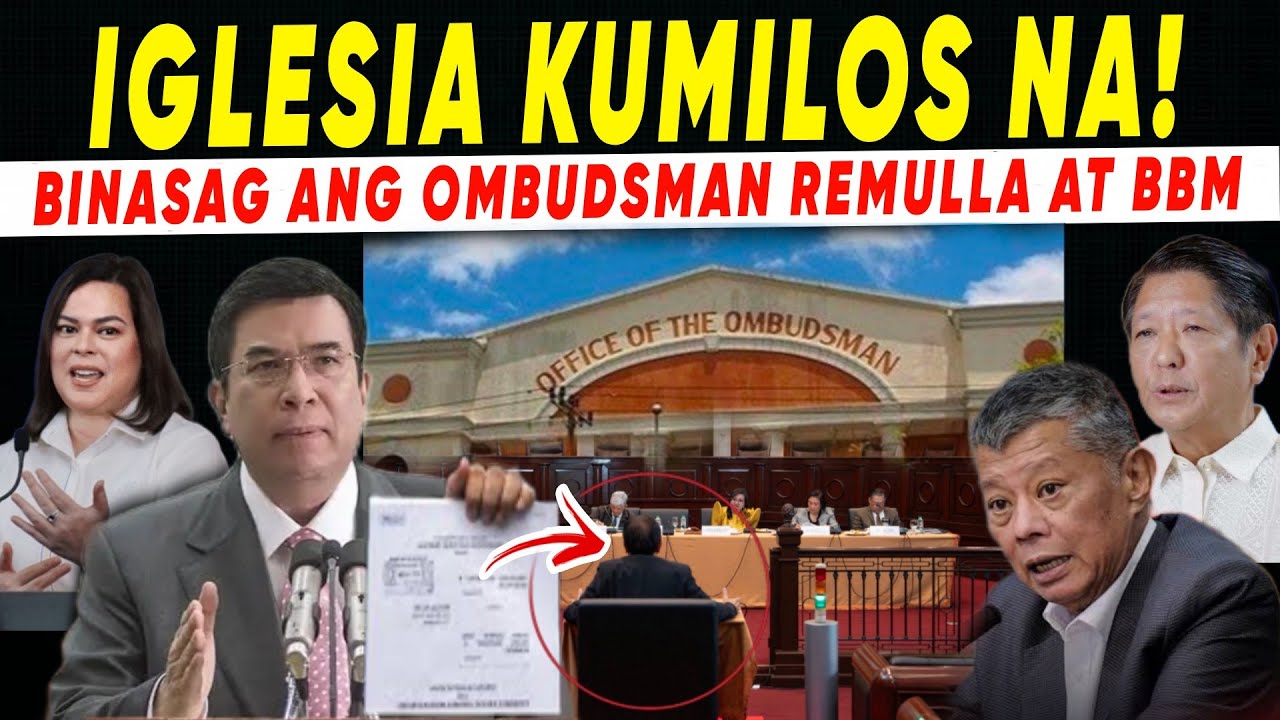
The Reckoning: Faith and Political Fire Collide Over Philippines’ Biggest Corruption Scandal
In the relentless narrative of Philippine politics, moments of profound national tension often arrive not with a whisper, but a deafening clash of principles. The country currently stands at just such a perilous crossroads, caught between the gravity of a massive corruption scandal, the spiritual demands of a powerful religious institution, and the controversial appointment of a new anti-graft chief whose political past casts a long shadow over his ability to deliver impartial justice.
The crisis centers on the sprawling, multibillion-peso anomaly involving the state’s flood control projects—a conspiracy of alleged “ghost projects” that has drained the public coffer of staggering amounts of money intended for critical infrastructure. In the face of this systemic theft, the nation’s premier anti-corruption body, the Office of the Ombudsman, has been placed under the stewardship of a man whose loyalty is viewed by many with deep suspicion: Jesus Crispin “Boying” Remulla, transitioning directly from his post as Justice Secretary to the crucial role of Ombudsman.
A Powerful Voice for the People: The Iglesia ni Cristo’s Unprecedented Demand
Amidst the swirling rumors of investigation stoppages and political maneuverings to protect the highest-ranking culprits, a powerful and influential voice broke the silence, shifting the ground beneath the feet of the political establishment. The Iglesia ni Cristo (INC), through an official statement read on its affiliated network, delivered an unequivocal demand for justice, transparency, and accountability.
Speaking on behalf of the INC’s Executive Minister, Eduardo V. Manalo, the church’s leadership expressed their deep concern over the “extensive corruption” uncovered in the thousands of flood control projects across the administration. Their statement, framed with a powerful appeal for peace and justice from God, cut through the political noise and called for decisive action. The INC did not mince words: they demanded the continuation of the investigation—a direct and pointed response to rumors that the Senate leadership was considering halting the highly-anticipated probe for “unclear reasons.”
The Church further insisted that any investigation must be conducted with absolute transparency and impartiality. They singled out the newly established Independent Commission for Infrastructure (ICI), cautioning that a “secret” investigation would likely be rejected by the public and only exacerbate the existing “chaos and uncertainty.” For a religious institution of the INC’s stature to intervene so directly in a core matter of governance and public accountability is a move of monumental importance, effectively placing the full moral and spiritual weight of its followers behind the call to prosecute those responsible for the “theft of billions of pesos from the national treasury.” The INC’s message is clear: true peace can only be achieved through continued, unbiased investigation and the successful application of the rule of law. Their statement serves as a non-negotiable benchmark against which the new Ombudsman’s actions will be judged.
The New Guardian: Jesus Crispin Remulla at the Helm
The INC’s demand lands at a moment of pivotal institutional transition. President Ferdinand Marcos Jr. has officially named Jesus Crispin Remulla as the successor to retired Ombudsman Samuel Martirez. The Palace’s justification for the appointment is a recitation of praise for his legal and administrative career. They cite his work leading reforms at the Department of Justice (DOJ), including the modernization of the justice system, efforts to decongest national prisons, and the speedier resolution of cases. Furthermore, his long history as a legislator, Governor of Cavite, and lawyer is touted as proof of his “integrity and dedication” to public service.
Crucially, the Palace has pinned its hopes on Remulla to maintain transparency, strengthen anti-corruption measures, and ensure justice is “implemented fairly and quickly.” The implicit, yet profound, promise accompanying his appointment is that he will be impartial and “spare no one” (“Walang sasantuhin”), regardless of political clout or association. This is a promise that Remulla must not only uphold but aggressively demonstrate, for his arrival at the Ombudsman’s office is met not with universal confidence, but with a significant degree of anxiety and public skepticism.
The Shadow of Doubt: Political Loyalty vs. Public Trust
The public’s unease is not a matter of prejudice but a product of historical record. Remulla’s extensive background as a career politician, with decades of deep-rooted ties and alliances within the political landscape, has critics fearing that the “Tanodbayan,” the guardian of the people, will become an agent of a political faction.
The concerns stem from specific, high-profile instances during his tenure as Justice Secretary. One of the most frequently cited is his stance on the International Criminal Court (ICC), which critics claim signaled a willingness to prioritize political strategy over international accountability.
More immediately damaging to his image of impartiality was an infamous exchange during a Senate hearing. When a senator posited that “sometimes we have to bend the law to please the people,” Remulla’s response—“Yes sir, yes sir”—sent a shudder through the legal community. For the future anti-graft chief to agree, even passively, to the concept of compromising the law for expediency, however motivated, is viewed as a fundamental red flag.
The new Ombudsman faces the daunting challenge of overcoming his own history—a history that suggests a potential political bias—to fulfill a role that demands absolute neutrality. The fear is palpable: that he may be compelled by a sense of utang na loob (debt of gratitude) to his appointing power, or that he will weaponize his office, deepening the political divides by using its immense power to target political foes while shielding friends. The path before Remulla is clear: he must actively and immediately prove that the nakaraan (the past) is just that, and that his dedication to the law is now total, unbound by previous loyalties.
A Stalled Probe and the Cost of Inaction
The need for Remulla’s immediate and uncompromising action is underscored by the current, distressing state of the flood control investigation. The momentum has not just slowed; it appears to be grinding to a halt.
First, the key Senate Blue Ribbon Committee, which was conducting the high-profile hearings, saw the resignation of its chairman, Senator Panfilo Lacson. This leadership vacuum, combined with the imminent one-month Senate recess starting Friday, means the crucial public hearings will cease until the middle of November. This period of political inactivity is a dangerous window for those implicated, allowing evidence to be hidden and witnesses to be silenced or intimidated.
Second, the lack of decisive enforcement action is glaring. Despite explosive testimony from figures like former Governor Chavit Singson and allegations of money being transported in “maletas,” the Anti-Money Laundering Council (AMLAC) has yet to issue widespread freeze orders on the assets of all major individuals allegedly involved. The initial freeze orders targeted DPWH engineers and contractors, but key figures mentioned in the alleged conspiracy remain untouched, raising suspicions that they are being protected. The absence of swift asset forfeiture action allows the alleged conspirators to move or hide their ill-gotten wealth, potentially forever dooming the public’s chance to recover the stolen billions.
The consequences of this prolonged corruption and lack of accountability are already felt on the world stage. The article highlights the distressing report of Filipinos abroad being denied foreign currency exchange at international airports due to the country’s reputation for graft and money laundering. This is the ultimate, heartbreaking cost of official malfeasance: a national humiliation where the integrity of every Filipino passport holder is tainted by the actions of a corrupt few.
The True Test of the Tanodbayan
Jesus Crispin Remulla now sits in the seat of the Tanodbayan, the “watchman of the people,” wielding power that is both immense and terrifying. The Ombudsman possesses moto proprio power—the ability to initiate investigations on their own volition, based even on a mere tip or a piece of intelligence, without waiting for a formal complaint. This power gives him the authority to cut through political inertia and immediately launch inquiries into the flood control scandal’s deepest, most protected roots, even if the Senate or other agencies stall.
His seven-year term, unremovable by the President who appointed him, offers the ultimate opportunity for redemption. He has a unique chance to silence his critics by becoming the greatest anti-graft champion in Philippine history, or he risks having his name permanently etched in history as the individual who oversaw the death of accountability. The challenge is stark: Will he leverage his immense power to fulfill the promise of a government that serves the public trust, or will he fall prey to the political biases he is so strongly associated with?
The INC’s demand for unyielding transparency and the chilling reality of a corruption-stained international reputation now converge on Remulla’s desk. His inaugural moves regarding the flood control case will be the true test of his character, integrity, and dedication to the Filipino people. The hour of reckoning is here, and the nation watches to see if the powerful new Ombudsman will finally bring the long-awaited light of justice to the Philippines.
News
GULAT ANG LAHAT! Toby Tiangco, Huli sa Video na Nagtatangkang Harangin ang Suspensyon ni Kiko Barzaga – ‘Trojan Horse’ sa Kongreso Nabunyag?
Sa isang mainit na tagpo sa loob ng Batasang Pambansa na tila hinugot sa isang pelikula, isang hindi inaasahang “plot…

HINDI NA NAKAPALAG! Kiko Barzaga, Pinatayan ng Mikropono at Sinuspendi ng 60 Araw Matapos ang Matinding Harapan sa Kongreso Dahil sa ‘Fake News’
Sa isang mainit at dramatikong tagpo sa loob ng Batasang Pambansa, tuluyan nang ibinaba ang kamay na bakal laban…

GUARD! KALADKARIN NIYO PALABAS ANG MATANDANG ‘YAN! ANG BAHO NIYA, NAKAKAHIYA SA MGA PASYENTE KO!
Napakalakas ng bagyo nang gabing iyon sa lungsod. Ang hangin ay humahagupit sa mga bintana ng St. Luke’s Medical City…

LUMAYAS KA RITO! ANG BAHO MO! WALA KANG PAMBAYAD KAYA WALA KANG KARAPATANG MAGPAGAMOT DITO!
Sa gitna ng abalang lungsod ng Makati, nakatayo ang St. Raphael Medical Center, isang ospital na kilala sa makabagong kagamitan,…

The Uncomfortable Truth Exposed: Why the World’s Wealthiest Nations Are Reportedly Laughing at the Philippines and the Shocking Reason Behind Their Sudden Loss of Respect for the Pearl of the Orient!
It is a bitter pill to swallow for every patriotic Filipino, but a disturbing narrative is quietly circulating within the…

ARGUS Touches Hearts on Showtime as He Emotionally Bids Farewell to His Father
Manila, Philippines — It was a tear-filled episode of It’s Showtime as young singing sensation Argus delivered one of the most emotional…
End of content
No more pages to load