
In the high-stakes theater of Philippine politics, a Senate hearing is rarely just a hearing. It is a stage, and its players are often more interested in performance than procedure. But every so often, a line is crossed, a political gambit goes too far, and the real world smashes into the performance with unexpected force.
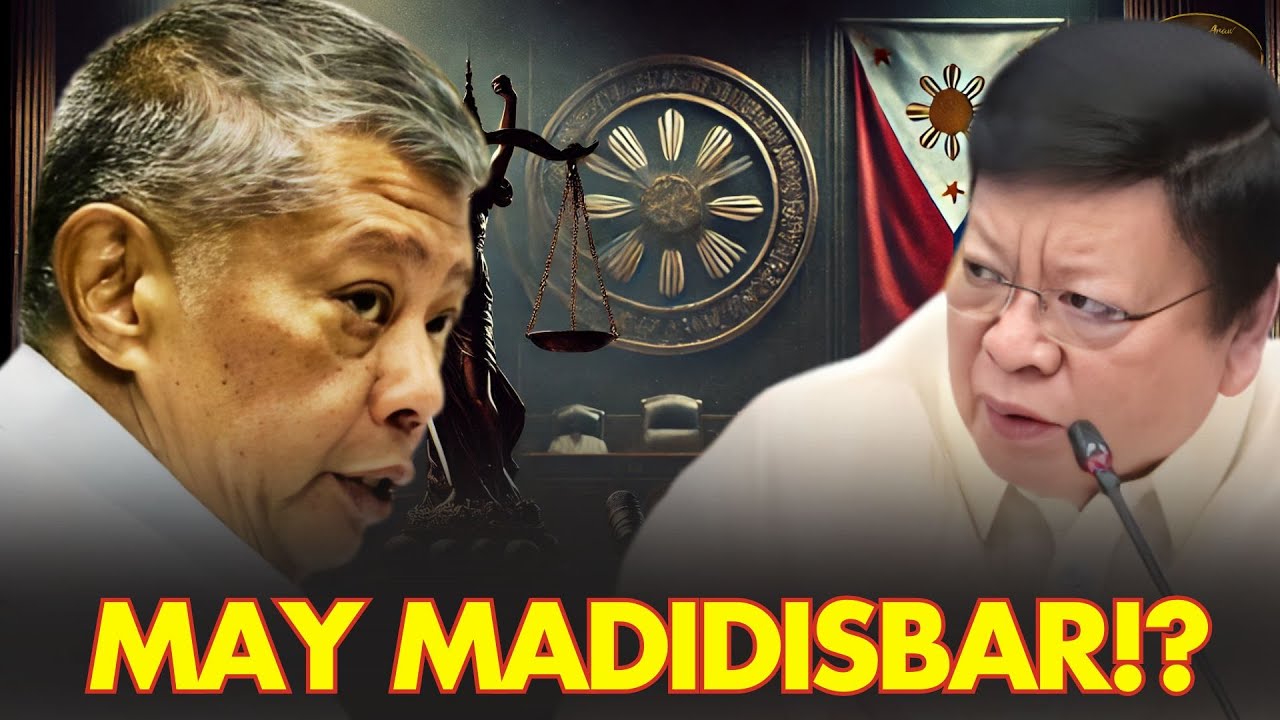
This is exactly what happened during a heated Senate Blue Ribbon Committee hearing. The session, ostensibly about flood control anomalies, devolved into a stunning one-on-one confrontation between Senator Rodante Marcoleta and Department of Justice Secretary, Crispin “Boying” Remulla.
The exchange was tense, but it was one line from Senator Marcoleta that sent a shockwave through the legal community. After accusing the Justice Secretary of articulating a mere “opinion” rather than the law, Marcoleta delivered a stunning, personal threat.
“You do not change the provision of law, Mr. Secretary,” Marcoleta warned, his voice sharp. “You may be disbarred from doing this.”
It was a breathtaking escalation. A sitting senator threatening the nation’s top lawyer with the loss of his legal license, live on a public broadcast. Marcoleta, known for his aggressive, prosecutorial style, had thrown down the gauntlet. He likely expected Remulla to stammer, to backtrack, to be politically cornered.
What he did not expect—what the title of the video “DI AKALAIN” (Didn’t Expect) perfectly captures—was that his challenge would be answered, not by Remulla, but by the highest authority representing the nation’s lawyers: the President of the Integrated Bar of the Philippines (IBP). And that answer would not just be a defense of Remulla, but a surgical, legal dismantling of Marcoleta’s entire argument.
The Confrontation: The Spirit vs. The Letter of the Law
The fuse for this explosion was a technical but crucial argument about the Witness Protection Program (WPP). The committee was discussing state witnesses involved in massive corruption. Secretary Remulla, arguing for a commonsense approach, suggested that these witnesses, to prove their sincerity, should be required to return the ill-gotten wealth they received before they are fully admitted into the state’s protection.
Remulla’s position was one of practicality and morality. “Justice can only be attained if there is restitution,” he argued, framing it as a moral duty, even if not explicitly spelled out as a prerequisite in the law. He was arguing for the spirit of the law, insisting that the state should not be protecting individuals who are still clutching the very money they helped steal.
This was the opening Marcoleta was waiting for. He pounced, accusing Remulla of inventing law out of thin air. “Hu…wag po ninyong babaguhin ang requisite ng batas, Mr. Secretary,” (Do not change the requisites of the law, Mr. Secretary), he demanded.
Marcoleta’s argument was simple: show me the black-and-white text. “You cite the law that it [restitution] come before!” he challenged. He argued that there were no official “findings” yet on how much money needed to be returned, so Remulla’s demand was baseless. To Marcoleta, Remulla was operating on “such a reasoning” and “opinion,” while he, the senator, was “articulating the provision of law.”
This set the stage for his ultimate threat: disbarment. In Marcoleta’s view, Remulla was committing a lawyer’s cardinal sin—placing his personal “opinion” above the written law.
The Unexpected Arbiter: The IBP President Responds
Marcoleta had made his move, and it was a powerful one. He had painted Remulla as legally incompetent. But the senator’s victory lap was cut short.
The political brawl had caught the attention of the legal community, and the IBP President, Attorney Alan Panolong, was asked to weigh in. In a subsequent interview, Panolong was presented with the core question: Was Remulla inventing a requirement, or was Marcoleta missing something?
Panolong’s response, as the video’s narrator gleefully describes, was a “supalpal” (a slap-down). He didn’t just offer an opinion; he brought the law books.
He confirmed that Secretary Remulla’s “moral” position was, in fact, entirely supported by the letter of the law. The very law Marcoleta demanded to see.
The Legal Takedown: Deconstructing the Law
First, Panolong pointed to the exact legislation in question: Republic Act 6981, the Witness Protection Act. He cited Section 5, which, while not using the word “restitution,” states that a witness, to be admitted, must comply with their “legal obligations and civil judgements” against them.
This was the first pillar of his argument. What is a “legal obligation”?
Panolong explained that in many of these corruption scams, witnesses admit to receiving kickbacks as part of their testimony. The moment they make that admission, they are under a clear “legal obligation” to return those funds. This isn’t a future requirement; it’s a present one.
Second, and more devastatingly, Panolong introduced a fundamental legal concept that had been entirely absent from the Senate debate: “unjust enrichment.” He cited Articles 22 and 23 of the Philippine Civil Code. This principle, foundational to all Philippine law, states that you cannot benefit from something you are not legally entitled to. If a person received millions in kickbacks—money that clearly doesn’t match their legal salary—they are “unjustly enriched,” and the law obligates them to return it.
Therefore, Remulla’s demand for restitution wasn’t a “new” requirement. It was an enforcement of one of the oldest and most basic principles in the Civil Code.

Third, Panolong clarified the process. A state witness, upon qualifying, signs a Memorandum of Agreement (MOA). This contract “operationalizes” their testimony and their obligations. Showing “sinceridad” (sincerity) is a key criterion for the WPP. And what better way to prove sincerity, Panolong argued, than to fulfill your legal obligation and return the stolen money?
This point was later reinforced by another legal expert, Attorney Joseph Noel Estrada, who noted that sincerity must be demonstrated first. Otherwise, the witness is simply “using the law to save [themselves]” while keeping the fruits of the crime.
The Disbarment Threat Backfires
In a matter of minutes, the IBP President had systematically dismantled Marcoleta’s entire case. The senator, who had so confidently claimed to be “articulating the provision of law,” had apparently overlooked the Witness Protection Act’s own Section 5, the entire concept of unjust enrichment in the Civil Code, and the procedural realities of the MOA.
Remulla’s “opinion” was, in fact, a legally sound and defensible position. His argument for the “spirit of the law” was fully aligned with the “letter of the law.”
The fallout from this legal correction is profound. The threat of disbarment, which Marcoleta had aimed at Remulla, now hangs awkwardly in the air. The video’s narrator, sensing the irony, asks the obvious question: “Sino nga ba ang madi-disbar?” (Who should really be disbarred?).
While a senator has immunity for speech during a session, the public correction from the head of the IBP was a humiliating political and professional blow. Marcoleta, in his attempt to create a “gotcha” moment, had been exposed as being legally out of his depth. He wanted a political fight but was instead handed a legal lecture.
This incident serves as a powerful case study in the escalating battle between political noise and legal substance. It was a rare, clarifying moment where the quiet authority of legal doctrine was called upon to silence the loud, aggressive posturing of politics.
Senator Marcoleta set out to prove the Justice Secretary was a bad lawyer. He failed. In the process, he received an unexpected, and very public, legal education from the President of the Lawyers himself. The checkmate was not political; it was purely, and devastatingly, legal.
News
GULAT ANG LAHAT! Toby Tiangco, Huli sa Video na Nagtatangkang Harangin ang Suspensyon ni Kiko Barzaga – ‘Trojan Horse’ sa Kongreso Nabunyag?
Sa isang mainit na tagpo sa loob ng Batasang Pambansa na tila hinugot sa isang pelikula, isang hindi inaasahang “plot…
HINDI NA NAKAPALAG! Kiko Barzaga, Pinatayan ng Mikropono at Sinuspendi ng 60 Araw Matapos ang Matinding Harapan sa Kongreso Dahil sa ‘Fake News’
Sa isang mainit at dramatikong tagpo sa loob ng Batasang Pambansa, tuluyan nang ibinaba ang kamay na bakal laban…

GUARD! KALADKARIN NIYO PALABAS ANG MATANDANG ‘YAN! ANG BAHO NIYA, NAKAKAHIYA SA MGA PASYENTE KO!
Napakalakas ng bagyo nang gabing iyon sa lungsod. Ang hangin ay humahagupit sa mga bintana ng St. Luke’s Medical City…

LUMAYAS KA RITO! ANG BAHO MO! WALA KANG PAMBAYAD KAYA WALA KANG KARAPATANG MAGPAGAMOT DITO!
Sa gitna ng abalang lungsod ng Makati, nakatayo ang St. Raphael Medical Center, isang ospital na kilala sa makabagong kagamitan,…

The Uncomfortable Truth Exposed: Why the World’s Wealthiest Nations Are Reportedly Laughing at the Philippines and the Shocking Reason Behind Their Sudden Loss of Respect for the Pearl of the Orient!
It is a bitter pill to swallow for every patriotic Filipino, but a disturbing narrative is quietly circulating within the…

ARGUS Touches Hearts on Showtime as He Emotionally Bids Farewell to His Father
Manila, Philippines — It was a tear-filled episode of It’s Showtime as young singing sensation Argus delivered one of the most emotional…
End of content
No more pages to load