
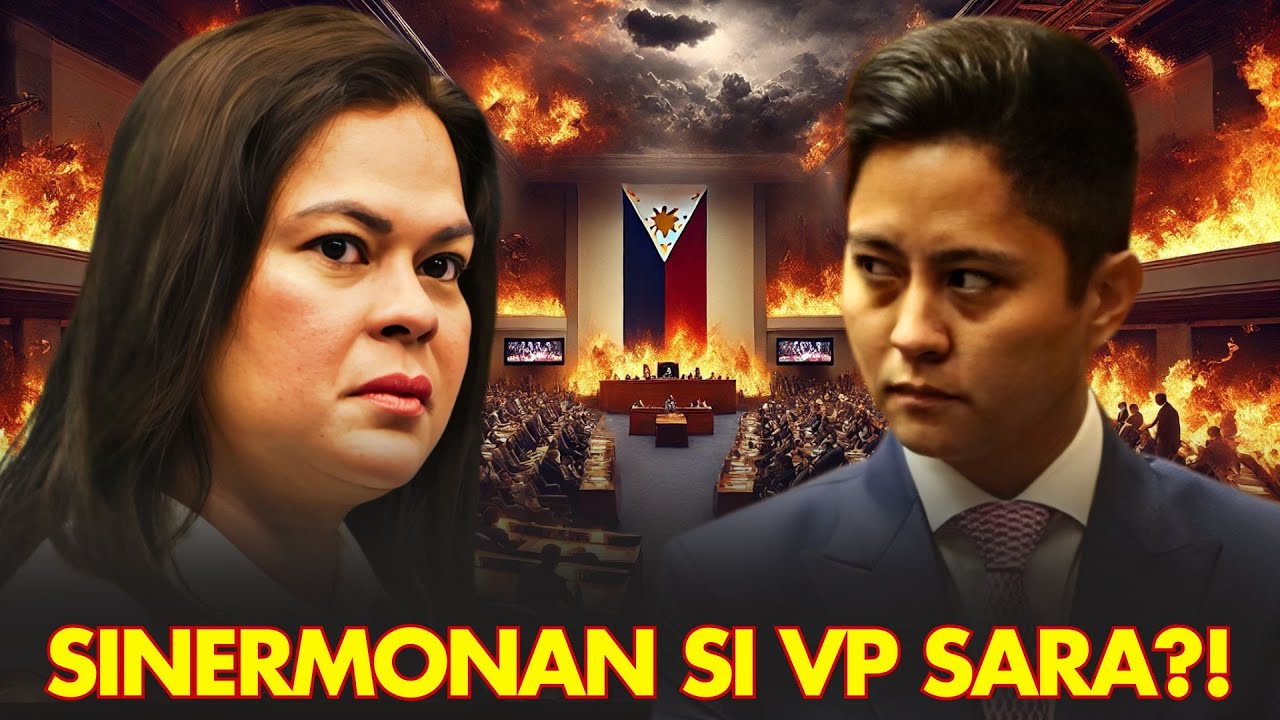
In the often-deafening arena of Philippine politics, silence can be louder than any speech. It was in a quiet, heavy atmosphere at the House of Representatives that Congressman Sandro Marcos, a figure who carries the undeniable weight of his name, stood to deliver what was ostensibly a simple address. There were no grand gestures, no thunderous applause, and no raised voice. Yet, the words he spoke have since echoed with the force of a political tremor, one that threatens to crack the very foundations of the nation’s most powerful alliance.
This was not a typical speech. It was, as many observers have since labeled it, a “sermon.” And its target, though unnamed, seemed unmistakably clear.
“Public service is not just a job,” Marcos stated, his words cutting through the chamber. “It is a lifelong commitment.” He continued, adding a phrase that would become the speech’s undeniable thesis: “Governance exists not to rule, but to uplift.”
To the casual listener, these might sound like noble, if common, political platitudes. But in the super-heated, deeply personal context of today’s political landscape, they were anything but. This was a message, a calculated statement delivered at a time of visible and growing friction between the Marcos and Duterte dynasties. It was a verbal line drawn in the sand, a declaration of principles that seemed to stand in stark contrast to the controversies now swirling around their supposed “UniTeam” partners.
The elephant in the room, of course, is the intense, ongoing scrutiny over the massive confidential and intelligence funds sought and utilized by Vice President Sara Duterte. As questions about accountability, transparency, and the very nature of these “secret” funds dominate the national conversation, Sandro Marcos’s words take on a precise and pointed meaning.
When he speaks of those who must be reminded that governance is not a “privilege,” who else could he be referencing but those currently under fire for using public money with minimal oversight? When he condemns the idea of “ruling” rather than “uplifting,” is he not-so-subtly pointing to a political style that often prioritizes power and authority over humble service?
The speech was a masterclass in political messaging. By never mentioning a single name—not “Duterte,” not “VP,” not “confidential funds”—Marcos achieved something far more potent. He forced everyone to connect the dots themselves. The lack of a direct accusation made the implied one all the more powerful. It was a “papiaw na hampas,” a subtle-yet-stinging whip, aimed directly at those who, in his words, “have forgotten who they truly serve.”
This event is more than just a single speech; it is a critical marker in the rapidly deteriorating relationship between the two families that swept into power on a unified ticket. The “UniTeam,” once a symbol of seemingly untouchable political consolidation, has been showing deep and undeniable cracks. From open disagreements on policy to veiled barbs from key allies on both sides, the alliance has been strained. Marcos’s speech feels less like an attempt to repair the damage and more like a decision to define his side of the rift.
He is, in effect, drawing a moral and philosophical distinction. He is positioning his camp—and by extension, his father’s administration—as the one committed to “lifelong commitment” and “uplifting” the people. The implication, left hanging heavy in the air, is that the other side is not. He is casting them as the ones who view their position as a “privilege” and who have, perhaps, become “addicted to power.”
 The video analyzing this speech aptly brings in a religious and moral framework to dissect the message, quoting from the Book of Mark: “Whoever wants to become great among you must be your servant, and whoever wants to be first must be slave of all.” This biblical parallel deepens the interpretation of Marcos’s speech as a “sermon.” He wasn’t just making a political point; he was making a moral one. He was casting this divide not just as a disagreement over funds or strategy, but as a fundamental difference in one’s “heart” and “fear of God.”
The analysis further challenges the public to reflect: In an era of rampant corruption, greed, and abuse of power, how many leaders truly live by this principle of servitude? The speech becomes a mirror, forcing citizens and politicians alike to ask themselves if they are using their positions for personal gain or for the good of others. It’s a call to “wake up” and to be more discerning.
What makes this move so significant is who Sandro Marcos is. As the son of the President and a Senior Deputy Majority Leader, he is not a fringe politician. He is a core member of the administration’s leadership. His words carry the weight of the Malacañang Palace. This was not a rogue statement; it was a sanctioned message. It signals a clear and intentional shift in the political narrative, an attempt by the Marcos camp to seize the high ground and define their political brand in opposition to their crumbling alliance.
The public reaction has been one of stunned silence, followed by a flurry of analysis. As the commentary noted, the Duterte camp has been conspicuously quiet. There has been no direct rebuttal, no fiery response. This silence is perhaps the most telling reaction of all. It suggests they were, at the very least, caught off-guard, and are now weighing their response to a challenge that was as indirect as it was hostile.
This quiet, calculated speech may one day be seen as the moment the cold war between the Marcoses and Dutertes went public. It was a declaration that the days of pretending all is well are over. Sandro Marcos has redefined the terms of leadership, and in doing so, has publicly called into question whether his allies ever met them. He has laid down a gauntlet, not with a shout, but with a whisper, and the entire nation is now holding its breath to see who, if anyone, dares to pick it up.
The question that remains is what happens next. Will this “sermon” fall on deaf ears, dismissed as mere political posturing? Or has Sandro Marcos just ignited a new chapter in Philippine politics, one where the battle lines are drawn not between parties, but between two fundamentally different definitions of what it means to lead? One thing is certain: this was not the end of the conversation. It was the beginning.
News

GULAT ANG LAHAT! Toby Tiangco, Huli sa Video na Nagtatangkang Harangin ang Suspensyon ni Kiko Barzaga – ‘Trojan Horse’ sa Kongreso Nabunyag?
Sa isang mainit na tagpo sa loob ng Batasang Pambansa na tila hinugot sa isang pelikula, isang hindi inaasahang “plot…

HINDI NA NAKAPALAG! Kiko Barzaga, Pinatayan ng Mikropono at Sinuspendi ng 60 Araw Matapos ang Matinding Harapan sa Kongreso Dahil sa ‘Fake News’
Sa isang mainit at dramatikong tagpo sa loob ng Batasang Pambansa, tuluyan nang ibinaba ang kamay na bakal laban…

GUARD! KALADKARIN NIYO PALABAS ANG MATANDANG ‘YAN! ANG BAHO NIYA, NAKAKAHIYA SA MGA PASYENTE KO!
Napakalakas ng bagyo nang gabing iyon sa lungsod. Ang hangin ay humahagupit sa mga bintana ng St. Luke’s Medical City…

LUMAYAS KA RITO! ANG BAHO MO! WALA KANG PAMBAYAD KAYA WALA KANG KARAPATANG MAGPAGAMOT DITO!
Sa gitna ng abalang lungsod ng Makati, nakatayo ang St. Raphael Medical Center, isang ospital na kilala sa makabagong kagamitan,…

The Uncomfortable Truth Exposed: Why the World’s Wealthiest Nations Are Reportedly Laughing at the Philippines and the Shocking Reason Behind Their Sudden Loss of Respect for the Pearl of the Orient!
It is a bitter pill to swallow for every patriotic Filipino, but a disturbing narrative is quietly circulating within the…

ARGUS Touches Hearts on Showtime as He Emotionally Bids Farewell to His Father
Manila, Philippines — It was a tear-filled episode of It’s Showtime as young singing sensation Argus delivered one of the most emotional…
End of content
No more pages to load