
The name “Pacquiao” is more than just a name. It is a symbol of impossible triumph, a global brand, a synonym for a Filipino legend who punched his way from abject poverty to god-like status. Manny Pacquiao is the “Pambansang Kamao,” the National Fist, an eight-division world champion whose life is an open book.
Or so we thought.

For nearly two decades, a parallel story was unfolding in the shadows, a story of a mother’s relentless fight, a child’s quiet suffering, and a secret that was hidden in plain sight. This is the story of Emmanuel “Eman” Bacosa Pacquiao, the son who lived almost 20 years without his father’s name.
It’s a narrative that begins not in a boxing ring, but in a dimly lit billiard hall in Malate, Manila, and culminates in a moment of redemption that was two decades in the making.
Chapter 1: The Spotter and The Superstar (April 2003)
The year was 2003. Manny Pacquiao was the hottest name in boxing, fresh off a star-making, brutal victory against Marco Antonio Barrera. He was 24 years old, a rising national hero, and already married to his wife, Jinkee.
His nights, when not in training, were spent with friends, basking in the glow of his newfound fame. His frequent haunt was a popular billiard hall inside City Square, a bustling entertainment hub within the Pan Pacific Hotel in Malate.
Working there was Joan Rose Bacosa. She was a spotter and a waitress, navigating the lively, smoke-filled room. This is where their paths crossed.
According to Joan, Manny was polite, endlessly cheerful, and playful. In the noisy, chaotic hall, they struck up a friendship. He was a boxer on the verge of global superstor-dom; she was a young woman trying to make a living.
In the weeks that followed, the friendship deepened. Manny’s visits became more frequent. The brief hellos turned into long conversations. The long conversations turned into dinners.
A “special connection” was formed.
Joan would later claim she wasn’t immediately aware of the full details of Manny’s personal life. By her account, their meetings became serious. They took out-of-town trips. Manny, she said, provided her with an allowance and support.
It was a whirlwind romance, conducted in the private spaces left behind by a very public life. But this secret connection, built over just a few short months, was about to change both of their lives forever.
Joan Rose Bacosa was pregnant.
Chapter 2: A Pregnancy in the Shadows
The news of a child instantly changed the dynamic. The carefree, playful connection was now a life-altering reality, and a massive complication for a married, high-profile athlete.
According to Joan’s account, Manny’s instructions were swift and clear: Stop working. Move houses.
The goal was to avoid gossip, to shield his public image from the consequences of his private one. Joan, now carrying his child, was moved into the shadows.
In the beginning, the communication held. Manny reportedly stayed in contact with her through the initial months of her pregnancy. But as her due date approached, the calls became rarer. The support, once so present, began to fade. The distance grew, and the silence became heavier.
Joan was facing the terrifying prospect of giving birth to the son of a national hero, entirely alone.
On January 2, 2004, Joan gave birth to a baby boy. She named him Emmanuel Eman Bacosa.
This tiny child, who shared the name of a giant, was born into a world of profound contradictions. He was the son of one of the most famous, wealthiest men in the Philippines, yet he had no legal claim to him.
A year later, in 2005, Joan made a move that was both a legal declaration and an act of maternal hope. At Eman’s baptism, the certificate listed the father’s name: “Manny Pacquiao.” His profession: “professional boxer.”
She had documented the truth in the eyes of the church and the state. But the man himself, the father, remained publicly silent. The acknowledgment she and her son craved did not come.
Chapter 3: The Fight for a Name (2006-2011)
Years began to pass. Eman was a toddler, learning to walk and talk, completely unaware of the legacy in his blood. Joan Rose, however, was facing the daily struggle of raising a child alone, a child whose father’s face was plastered on every billboard and television screen.
By 2006, her patience was gone. She decided to fight back.
Joan did the one thing that was guaranteed to get a response: she went to the media. She made a public plea, a desperate call for Manny to recognize his son and provide regular support.
This was not just a mother’s appeal; it was a legal gambit. She filed a formal child support case against Manny Pacquiao in the Makati Regional Trial Court.
This was a direct, public challenge to the “Pambansang Kamao.” The press had a field day. The private life of the people’s champ was suddenly, and messily, on trial. The case promised to be an explosive spectacle, a deep dive into the secrets of a man who was becoming an international icon.
But just as quickly as it began, it was over.
After several months, the public firestorm was extinguished. An “out-of-court settlement” was reached.
Joan Rose Bacosa was made to sign a confidentiality agreement.
The terms of the settlement were sealed. The legal case was discontinued. In exchange for financial support, silence was purchased. The gossip faded, the media moved on, and Joan and Eman disappeared from the public eye.
For five years, the silence held, as per the agreement.
But in 2011, Joan reappeared. She once again spoke to the media. This time, her tone was different. It was less about the legal fight and more about the human cost. She expressed a mother’s simple, aching hope that one day, her son would finally be recognized by the man who gave him life.
She had been paid to be quiet, but the one thing she truly wanted—her son’s identity—had not been part of the bargain. Her persistence and courage were remarkable. She was a mother who refused to let her son be a footnote, a secret, or a transaction.
Chapter 4: The Hell of “Anak sa Labas”
While Joan fought her battles in courtrooms and in the media, her son, Eman, was fighting his own, far more brutal war on the playgrounds and in the schoolyards of Davao del Norte.
The source provides a heartbreaking glimpse into the life of the unacknowledged son. Eman admitted in a tearful recollection that he knew from a very young age exactly who his father was. How could he not? His father was, quite literally, the most famous man in the country.
This knowledge was not a comfort; it was a curse.
He was relentlessly bullied. His classmates, with the casual cruelty of children, branded him with the most painful label in Filipino culture: “anak sa labas,” or “child born out of wedlock.”
He was the “illegitimate” son, a living, breathing symbol of his father’s infidelity.
The torment was not just social. Eman’s childhood was marked by severe hardship, a shocking contrast to the life of his father, who by this point was one of the wealthiest athletes in the world.
Eman recounted experiencing mistreatment from a stepfather. He spoke of enduring “severe hunger and hardship,” particularly during a period when his mother, Joan (who is now a pastor in North Cotabato), was working abroad.
The juxtaposition is staggering.
While Manny Pacquiao was winning world titles, buying mansions in Forbes Park, and being celebrated as a devoted family man, his other son, Eman, was hungry.
While the world praised Manny, Eman was being abused.
While his half-siblings lived lives of unimaginable privilege, Eman was being taunted as an outcast.
This was the private hell that Eman Bacosa endured for nearly two decades. He was the son of a king, living the life of a pauper, all because he lacked the one thing that mattered: his father’s name.
Chapter 5: The Signing (2022)
Then, in 2022, after almost 20 years of silence, something changed.
The source material does not explain the catalyst. It does not say what private conversation, what change of heart, or what final plea from Joan or Eman broke through the two-decade-long impasse.
But what happened next was a seismic shift.
Manny Pacquiao, the senator, the legend, the father, finally did the one thing Joan Rose Bacosa had been fighting for since 2004.
He signed the documents.
He officially, legally, and publicly accepted Eman as his son.
The legal process was finalized. Eman Bacosa, the “anak sa labas,” was no more. In his place, a new man was born, at least on paper: Emmanuel “Eman” Bacosa Pacquiao.
For Eman, the moment was overwhelming. The source describes his reaction as one of “immense joy.” It was the end of a lifetime of ambiguity, of being “outside.” It was a validation he had waited 20 years to receive.
The signing of a piece of paper was not just a legal formality. It was a key, unlocking his identity.
It was also, as the source notes, a “significant boost” for the other area in his life where he was following his father: the boxing ring. Eman had already started his own boxing career, fighting as Eman Bacosa. Now, he would fight as Eman Pacquiao, carrying all the pressure, and all the privilege, that name implied.
Conclusion: The Weight of a Name
The story of Joan Rose Bacosa and Eman Pacquiao is a profound and complex chapter in the life of a national hero. It is a story that forces a difficult reconciliation between the public icon and the private man.
Manny Pacquiao’s journey from poverty to glory is a source of inspiration for millions. His life with Jinkee and their children is the public, celebrated face of his family.
But Eman’s story is a reminder that legacies are often more complicated than the legends we build.
It is a story of a woman, Joan Rose, who met a rising star in a billiard hall, and spent the next 20 years fighting a lonely, persistent battle for her son’s identity, even after being silenced by a confidentiality agreement.
It is the story of a boy, Eman, who endured hunger, bullying, and the psychological torment of being the “other” son, all while his father was celebrated as a global hero.
And it is, ultimately, the story of acceptance. The moment Manny Pacquiao signed his name was an acknowledgment of a 20-year-old truth. For Eman, it was the end of his first and longest fight. His immense joy at that moment was not just about a name; it was about finally being seen.
Today, Eman Pacquiao is an undefeated professional boxer, fighting under the banner his mother secured for him. He is finally, and officially, his father’s son.
News

Ang High-Tech na Mansyon ni Alden: Bakit Ang Dream House ng Aktor ay Literally Katabi ng Bahay ni Kathryn Bernardo
Ang mundo ng showbiz ay isang entablado kung saan ang pangarap ay nagsasaling-wika sa katotohanan, at ang pag-ibig ay madalas…

Araw ni Bonifacio 2025: Ang Trillion Peso March, Pagtawag ni Catriona Gray sa Pananagutan, at Ang “Under Control” na Gulo sa Mendiola
Ang Araw ni Bonifacio, na ginugunita tuwing Nobyembre 30, ay tradisyonal na ginagamit bilang plataporma ng sambayanan upang ipahayag ang…
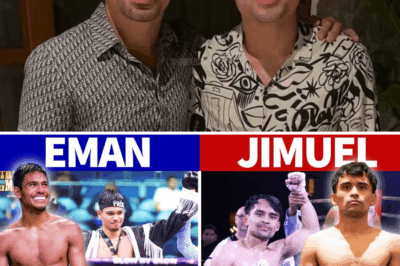
Ang Laban ng mga Mana: Eman vs. Jimwel Pacquiao – Sino sa mga Anak ni Manny Ang Hahawak sa World Title ng Boxing
Sa mundo ng professional boxing, ang pangalan ni Manny “Pacman” Pacquiao ay hindi lamang isang apelyido; ito ay isang simbolo…

Ginto, Bilyong Insertions, at Ang ICC Drama: Ang Naglalagablab na Katotohanan sa Likod ng Marcos Administration’s Sekreto
Ang pulitika sa Pilipinas ay muling nagliliyab, hindi dahil sa isang kakaibang celebrity gossip, kundi dahil sa mga seryoso at…

Ang Second Life sa Kabaong: Paano ang Isang Pari, na Dating Combat Medic, ang Nagbunyag ng Drug Smuggling at Nagligtas ng Buhay sa Gitna ng Libing
Ang buhay ay madalas na punong-puno ng pagbabago, at ang paghahanap ng layunin ay kung minsan ay matatagpuan sa mga…

Ang No-Fail Test ng Kabutihan: Paano ang Helicopter Crash ang Nagbunyag sa Tunay na Ugali ng Kasintahan at mga Empleyado ng Bilyonaryo
Ang tunay na yaman ay hindi nasusukat sa dami ng ari-arian o sa bigat ng bank account; ito ay matatagpuan…
End of content
No more pages to load